Composition shingle covers most roofs from Grogan’s Mill to Creekside Park. It is the easiest material to get approved and the one whose color choice deserves the most care, because so many houses on a street share it.
“Acceptable roofing materials include tile, slate, composition shingles, stone coated or standing seam metal and cement-fiberboard products. All metal roofing must be free of any types of glossy finish.”
Section 1.6.H.4, The Woodlands Residential Development Standards, recorded December 10, 2024
“Composition shingles” is the standard’s term for asphalt shingles, both the flat three-tab kind and the thicker laminated “architectural” or dimensional shingle that most re-roofs in The Woodlands now use. The limits are on color: muted, and without color pattern. A heavily blended shingle with contrasting granules can fail that test even though the material is approved.
Laminated shingles are heavier, carry higher wind ratings in most product lines, and hide the slight unevenness of older decking better than a flat tab. On an original Panther Creek or Cochran’s Crossing roof, the step up from three-tab is often the main visible change, and the one worth naming in the application so the committee sees a profile change and not a surprise.
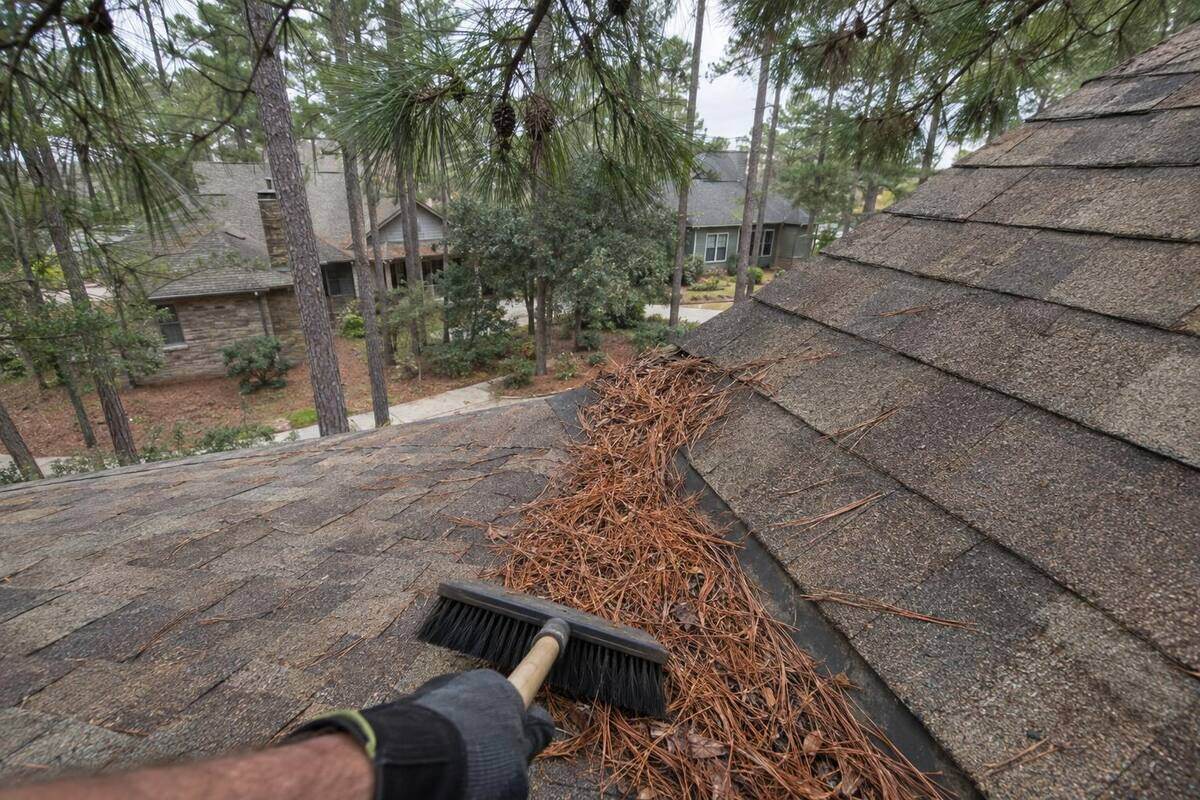
Shade and needles. A shingle under dense pine keeps moisture longer, grows algae streaks on north slopes and loses granules where branches brush it in wind. Needles pack valleys and the upslope side of chimneys and skylights, holding water against the shingle edge. None of that shows up on a warranty card, which assumes open sky.
Ask the contractor about algae-resistant granules, how valleys will be built (open metal valleys shed needles better than closed-cut ones on many roofs), and whether the attic ventilation matches what the shingle manufacturer requires for its warranty. In a 120°F summer attic, ventilation shortfalls cost shingle life quietly.
Grays, weathered woods and browns in low-contrast blends are what the villages mostly show from the street. A dark charcoal on a house under full canopy reads muted; the same shingle on an open lot in Creekside Park reads darker. Submit the sample board with the application, and look at it outdoors, in shade, before choosing.
Roof replacement is named as covered work in section 1.5.I.A, so submit even when nothing changes. Staff approval can apply where the material and color stay the same.
Shorter than the warranty suggests, often. Shade, moisture and branch contact age a shingle faster than open sun alone. An inspection every few years under heavy canopy catches valley and flashing trouble early.
Composition shingles are approved as a family; the standard does not require a laminated profile. Many manufacturers have narrowed their three-tab lines, which drives most re-roofs to architectural shingle anyway.
Say which village and whether the color is changing. That decides how the application reads.
Call (936) 703-2063 Request an Assessment Woodlands Roofing