Both kinds of metal roof are on the Township’s acceptable list, with one condition the standard spells out: no glossy finish of any kind. The choice between the two is mostly about what the house looks like from the street.
“Acceptable roofing materials include tile, slate, composition shingles, stone coated or standing seam metal and cement-fiberboard products. All metal roofing must be free of any types of glossy finish.”
Section 1.6.H.4, The Woodlands Residential Development Standards, recorded December 10, 2024
“Free of any types of glossy finish” rules out high-sheen paint systems and bare, reflective metal. Low-gloss and matte finishes in muted colors are what an application should propose, with a physical panel sample rather than a color swatch, because sheen does not show on paper.
Standing-seam is long, flat panels joined by raised seams with concealed fasteners. It reads modern and clean, suits the contemporary and transitional houses that turn up in every village, and sheds pine needles well because there is little for them to catch on. Stone-coated steel is steel pressed into shingle or tile profiles and finished with a granular coating, so from the street it resembles a shingle or tile roof. Committees tend to see it as a less dramatic change for a house that was built with shingle.
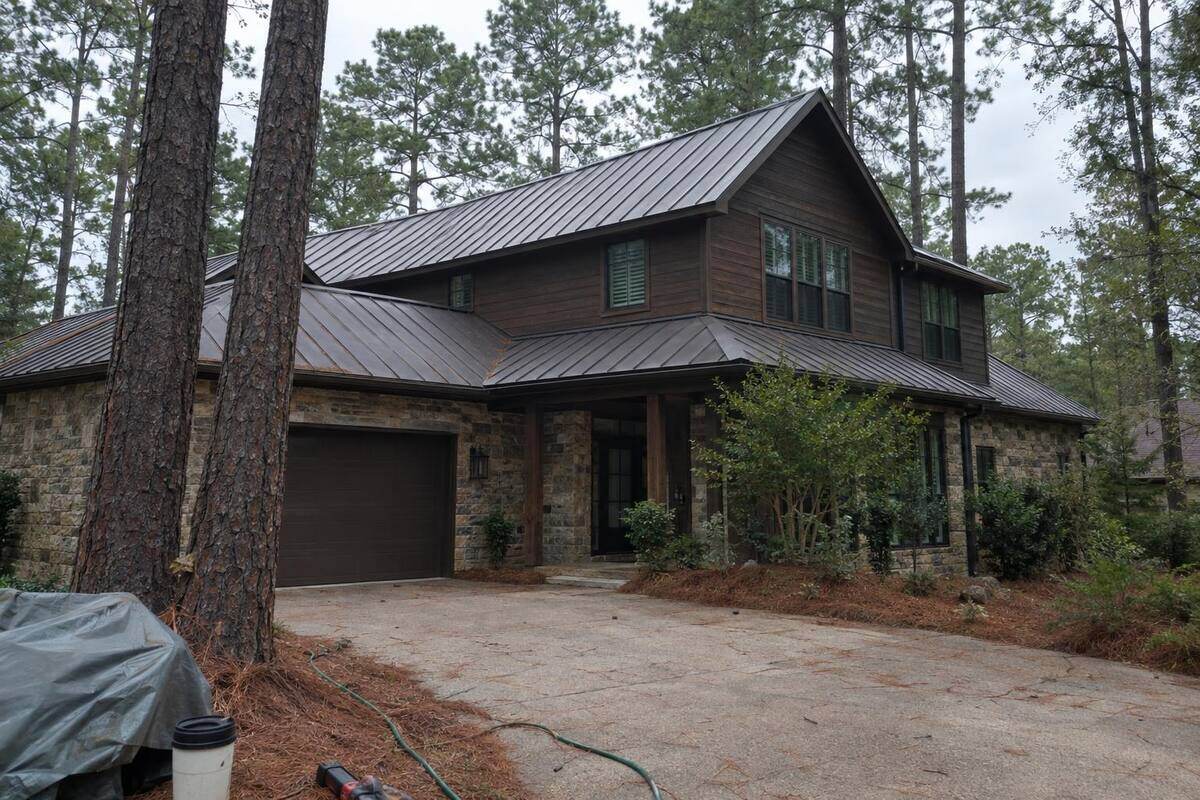
As a general industry range, metal roofs commonly run about one and a half to three times the installed cost of an architectural shingle roof, with standing-seam typically at the upper end. The spread depends on panel gauge, seam type, roof complexity and how many penetrations and valleys need custom flashing. Over a long enough ownership, a metal roof’s lifespan narrows that gap; over a short one it does not.
A falling limb dents metal where it would crack a shingle, and a dent in a standing-seam panel usually means replacing the panel, not patching it. Ask how panels are replaced after a strike and whether the color can be matched later. Oil-canning, a visible waviness in flat panels, is a cosmetic trait worth seeing in person on an installed roof before choosing a panel width.
Metal is also louder in rain only when it is installed over open framing. On solid decking with underlayment, which is how a re-roof on an existing house is normally built, most homeowners cannot tell the difference indoors.
Yes. Stone-coated and standing-seam metal both appear on the acceptable list in section 1.6.H.4, with the requirement that metal roofing be free of any glossy finish.
The same rule as every roof: colors that harmonize with the landscape, muted and without pattern. Dark bronze, charcoal and muted green-grays are the usual proposals. Submit a physical sample.
It is a change of material, which is exactly what review exists for. Expect the committee to look at the color, the sheen and how the roof fits the house and the street.
Ask for a written scope for both standing-seam and stone-coated, with a sample of each for the application.
Call (936) 703-2063 Request an Assessment Woodlands Roofing