Fiber-cement is what most homeowners replacing wood siding here end up choosing. It takes paint well, does not rot, and does not interest woodpeckers. How long it lasts depends almost entirely on how it goes on.
Shade and humidity keep walls damp, which is hard on wood. Fiber-cement, a mix of cement and cellulose fiber, is dimensionally stable in moisture, noncombustible, and unappealing to the insects and birds that go after cedar. It is made in lap, panel, shingle and board-and-batten profiles, so it can follow the look of the siding it replaces closely.
Clearance at the bottom: fiber-cement should not sit on the ground or in mulch, and it needs a gap above roofs where a wall meets a lower roof. Flashing at every window and door head. Sealed or primed cut edges. Correct fastening, not over-driven nails. Manufacturers publish installation requirements that their warranty depends on; ask the contractor to follow them and say so in writing.
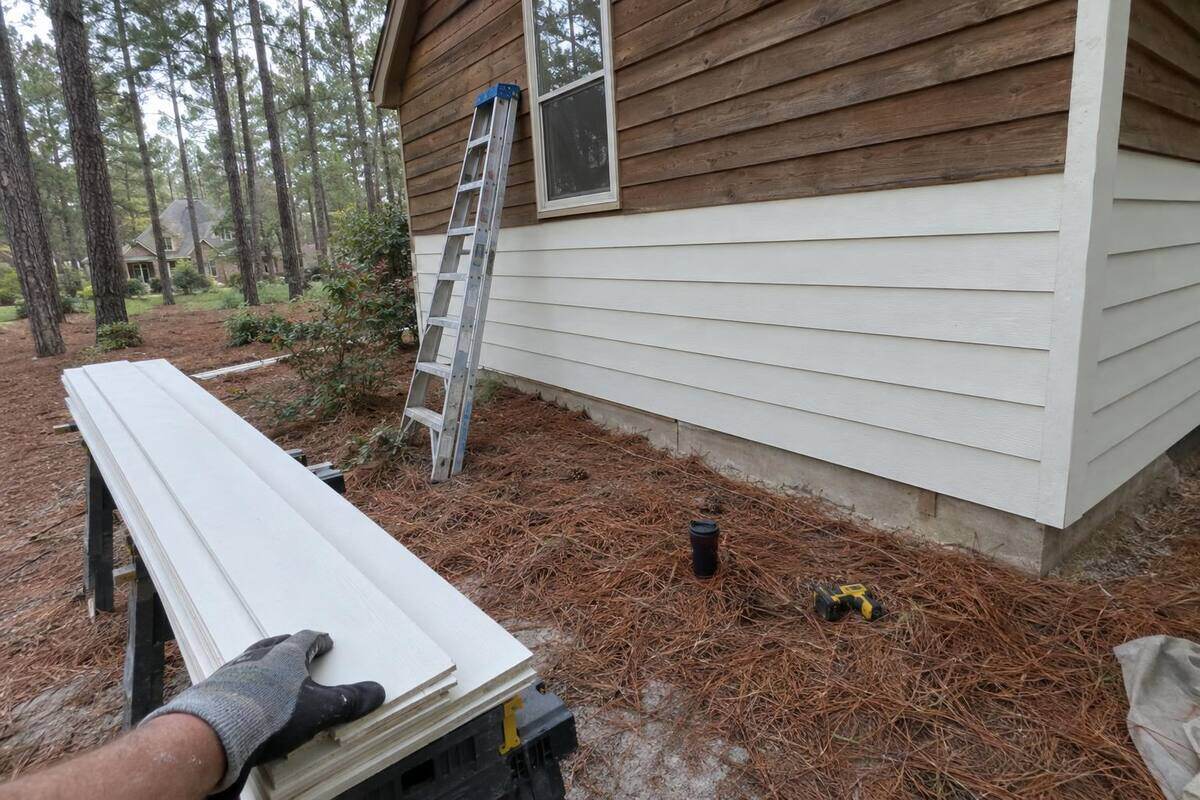
Fiber-cement is sold primed for field painting or with a factory finish. Either way, the color is reviewed: the standards call muted shades the most appropriate, accept muted whites in many neighborhoods, and prohibit gloss paint and high-gloss siding finishes (sections 1.6.H.1 and 1.6.H.5). Submit color chips; for a factory finish, a physical sample of the board.
When fiber-cement replaces wood, it is also a change of material, so the committee considers whether it is compatible with the house’s original character (1.6.H.3). A profile that echoes the original wood siding tends to make that easier.
Where a roof meets a wall, the roof flashing and the siding overlap. If both are due, doing them together, or at least in the right order, avoids cutting new work to reach old flashing. The roof replacement scope and the siding scope should agree about who handles that joint.
It is a common replacement material. As a change from wood it goes through design review, with the color and profile submitted.
Primed boards are painted after installation; factory-finished boards arrive painted. Both need touch-up at cuts and periodic repainting over the years.
James Hardie is one manufacturer of fiber-cement. Ask which product and line is being quoted.
Say what the siding is now and roughly how much of the house it covers.
Call (936) 703-2063 Request an Assessment Woodlands Roofing