Most roofs in The Woodlands need a repair long before they need replacing, and most leaks come from a handful of places. A repair is also the one kind of roof work that can often go ahead without a committee meeting, as long as it stays a repair.
Valleys. Packed with needles and leaves, a valley holds water against the shingle edges until it finds a way under. Many leaks in Panther Creek and Indian Springs trace back to a valley that has not been cleared in years.
Wall and chimney flashing. Two-story houses have long runs where a lower roof meets a wall. Step flashing there fails with age, and a missing kickout flashing at the bottom of the run sends water into the wall rather than the gutter.
Vent boots. The rubber collars around plumbing vents crack in the sun well before the shingles around them wear out.
Skylights. Common on older contemporary houses in the first villages, and a frequent source of slow leaks as their flashing ages.
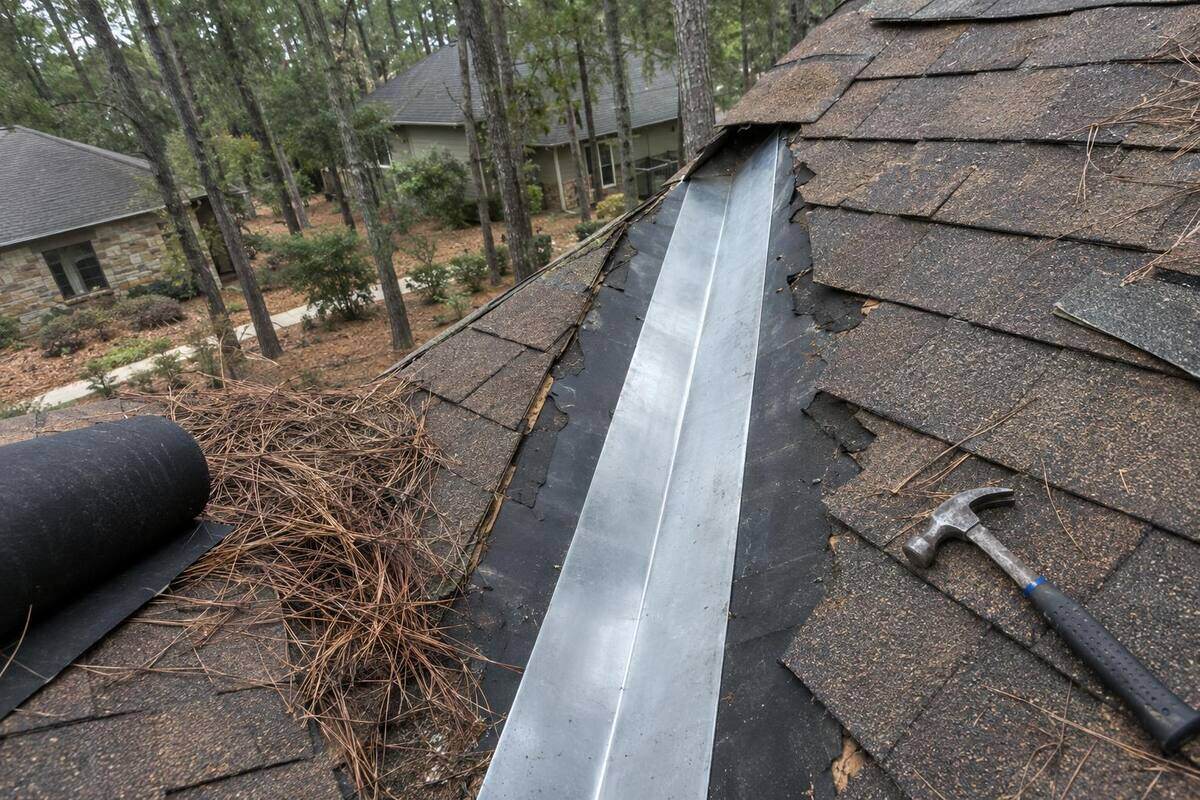
Section 1.5.I.A of the Township’s standards treats any work that alters more than half of the dwelling as needing an application, and names all roof replacement. A patch, a flashing repair or a replaced vent boot in matching material is a repair. A “repair” that replaces most of a slope in a different shingle is not, and should go in as an application. The contractor should say which side of that line the job is on before starting.
Attics here hold the air handler and its condensate pan, and sometimes water lines. A stain that appears on dry days, or in summer when the air conditioning runs hardest, points away from the roof. A stain that appears only in wind-driven rain points at flashing on the windward side. Tell the contractor when the stain shows up; it narrows the search.
If a roof needs repairs on several slopes at once, has widespread granule loss, or has soft decking in more than one spot, the conversation shifts to replacement. A good repair estimate says so plainly.
A like-for-like repair usually is not a replacement, but the standards cover work that alters more than half of the dwelling and any change of material or color. When in doubt, ask Covenant Administration before work starts.
Close, rarely exact. Shingles fade and product blends change. On a rear slope under shade it is hard to see; on the street side it may show.
Either. If a limb or tree caused it, see tree and storm damage, which covers what can be done before approval.
Say where it shows and when it appears. That narrows the visit.
Call (936) 703-2063 Request an Assessment Woodlands Roofing