A re-roof here has one step most places skip: written approval from the village committee or its staff before the tear-off. Everything else about doing it well is familiar, with the pines adding a few details of their own.
Assessment. The contractor looks at the roof and the attic, confirms what the roof is now and discusses whether anything is changing: the material, the profile or the color.
Application. The submission to the Township, with the product and a physical sample. The 2024 Residential Development Standards list all roof replacement as work that needs prior written approval (section 1.5.I.A), and give the committee up to 45 days from a complete application to act.
Tear-off and decking. Old shingles come off to the deck. Soft or delaminated decking, common under long-standing shade, is replaced; the scope should say how that is priced per sheet.
Underlayment, flashing, ventilation. New underlayment, new flashing at walls, chimneys and skylights rather than reused metal, and ventilation that matches the shingle maker’s warranty requirements.
Roof, cleanup and check. The roof goes on, the lot is swept for nails, and the finished work is checked against what was approved.
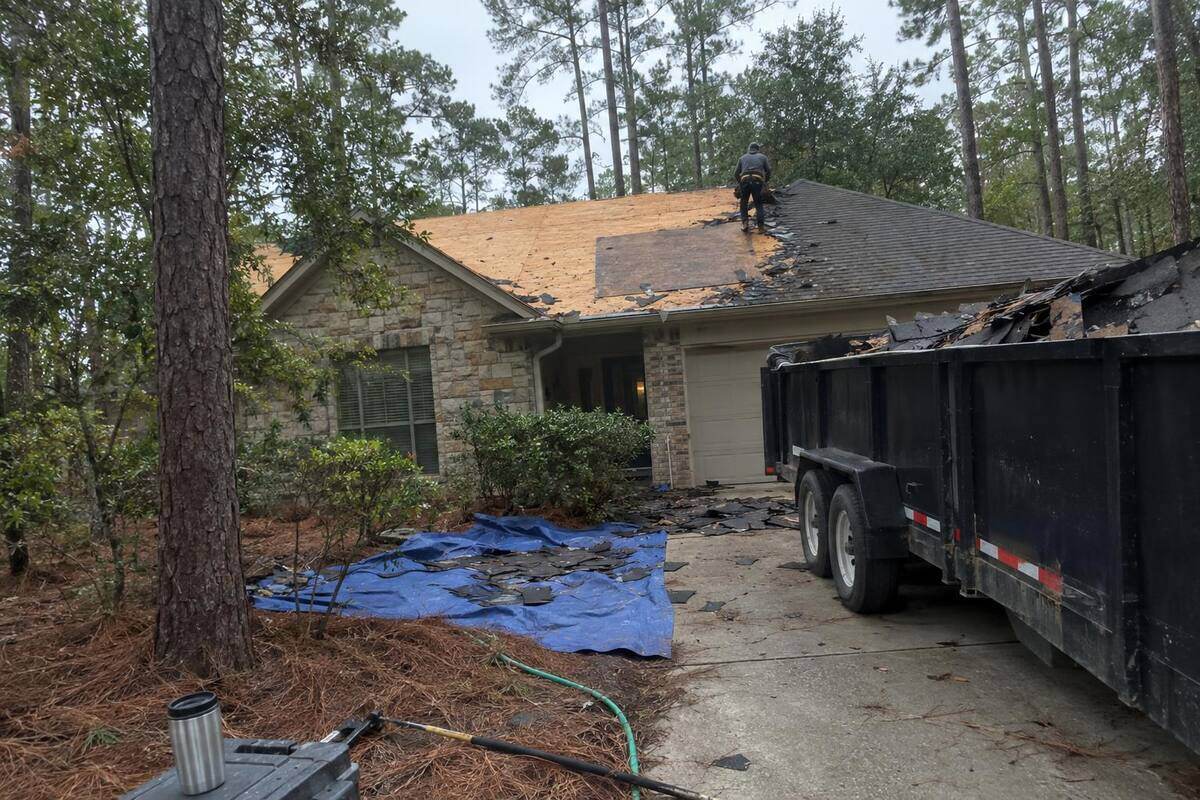
Access is the first thing. Many lots in Grogan’s Mill, Cochran’s Crossing and Panther Creek have trees close to the house on every side, which affects where the dumpster or trailer sits, how debris comes down, and how long the job takes. Ask about tree and bed protection before work starts, not after.
The second is valleys. Needles gather in valleys and on the uphill side of anything that interrupts the roof. How a valley is built matters more here than on an open lot, and overhanging limbs should be dealt with by an arborist before a new roof goes under them. Tree removal on a lot in The Woodlands has its own rules under the covenants; ask the Township before cutting.
The product line and color by name; the underlayment; how decking replacement is priced; flashing replaced, not reused; ventilation; who prepares the Township application; the workmanship warranty term; and cleanup. A scope that leaves out the application is a scope that leaves it to you.
The roofing itself is usually a few days for a typical house. The approval can take longer than the roofing, so the application should go in as soon as the product and color are chosen.
Not on a replacement. Approval comes first. The exception is emergency work to prevent further damage, which the standards allow without application.
No, but a change of color or material is part of what the committee reviews. Muted shades without pattern are the rule for every roof.
Say which village and whether anything about the roof is changing.
Call (936) 703-2063 Request an Assessment Woodlands Roofing