Cedar and other wood siding is common on older houses in the first villages, and much of it has now reached the end of its life. Replacing it is also a design-review question, because what goes on the wall changes how the house looks from the street.
Boards that are soft when pressed with a screwdriver, especially at the bottom course and around windows and doors. Splits and cupping that paint no longer holds together. Woodpecker holes and carpenter bee galleries, both common in a forest setting. Gaps at butt joints where the boards have shrunk. Mildew that returns within weeks of cleaning on shaded walls.
Spot repair is reasonable when damage is confined to a wall or a few courses. Once it is on every side of the house, replacing the siding usually costs less than chasing it board by board.
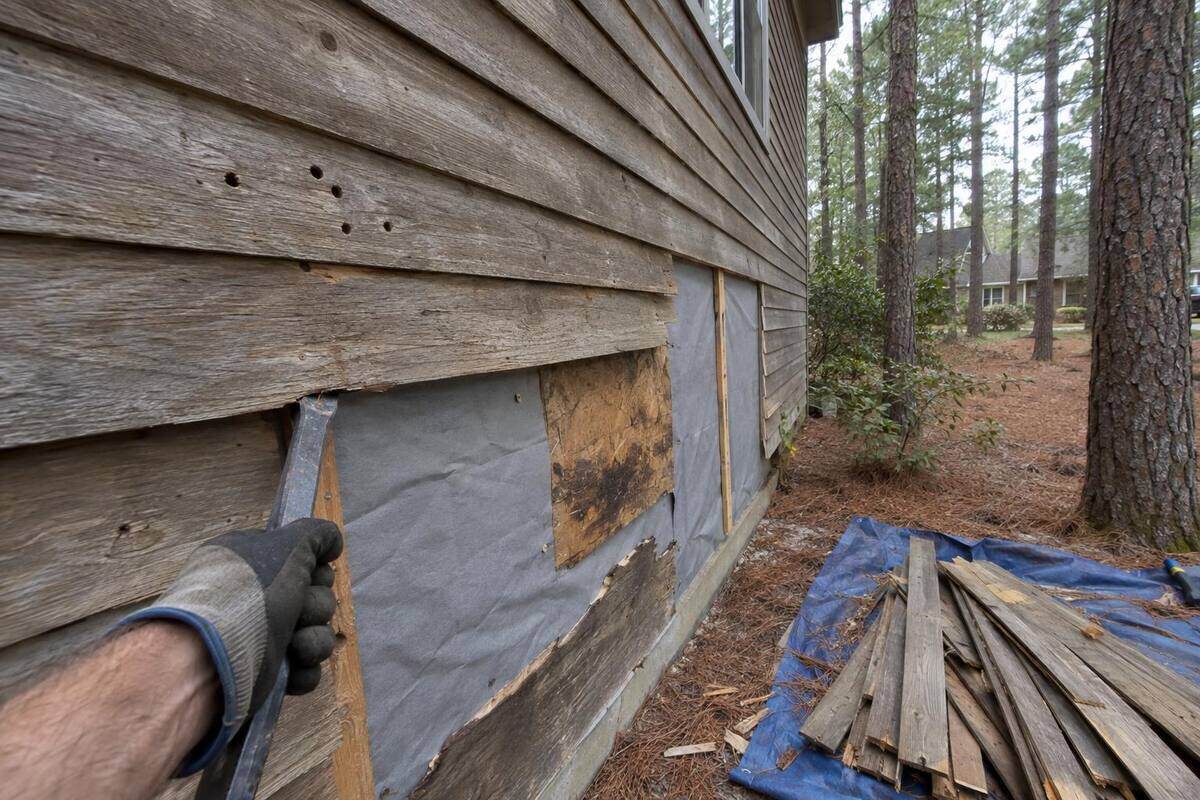
Replacing cedar with new cedar keeps the house’s character exactly and is the simplest review. Replacing it with fiber-cement, the usual alternative, gives a painted wall that resists rot, insects and woodpeckers far better, but it is a change of material. Section 1.6.H.3 of the Township’s standards asks that materials be compatible with the original architectural character of the house and the neighborhood, so expect the committee to look at the profile and the finish, not just the color.
The standards encourage colors that harmonize with the natural landscape and call muted shades the most appropriate, with muted whites acceptable in many neighborhoods (1.6.H.1). Gloss paint is prohibited, and siding with a high-gloss finish is listed as unacceptable (1.6.H.5). Repainting and color changes are reviewable work, and section 1.5.II.D requires color samples or chips with painting applications.
Old wood siding often hides rotted sheathing, missing flashing at windows and no weather barrier at all. A good scope includes house wrap, flashing at every opening, and a per-sheet price for sheathing replacement.
Often, with design review approval. It is a change of material, and the committee looks at how the new siding suits the house and the street.
The standards address color and gloss rather than requiring paint over stain. Muted colors and no high-gloss finish; submit samples.
Individual holes can be. Repeated damage on a wall is one of the more common reasons owners move to fiber-cement.
Say which walls and whether you want to keep wood or change material.
Call (936) 703-2063 Request an Assessment Woodlands Roofing