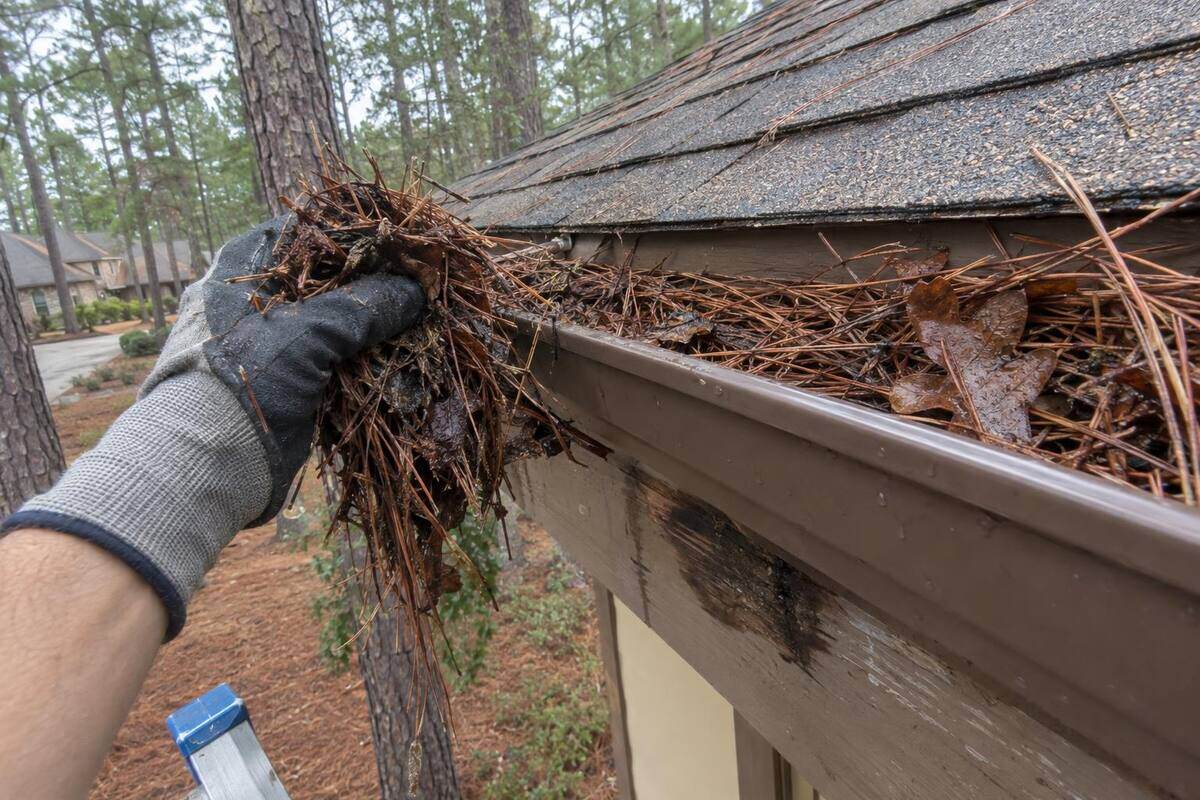
Gutters under pines fill faster than gutters anywhere else in the metro. When they overflow, water runs down fascia and siding and pools against a slab foundation. Most gutter problems here are the forest’s, not the gutter’s.
Pine needles are long and thin, and they slip through the openings of many leaf guards and then mat together inside. Oak leaves and pollen add to it. A gutter on a lot in Cochran’s Crossing or Sterling Ridge can fill in a single season. Once full, water spills over the front edge, or worse, behind the gutter onto the fascia board.
Fine-mesh guards designed for needles work better than large-opening screens or foam inserts, and still need an occasional brushing. Ask the contractor what the guard is designed to stop and how it is cleaned. No guard makes a gutter under pines maintenance-free.
Houses here sit on slabs in clay soil. Water dumped at the foundation wets the soil unevenly, and clay that swells and shrinks with moisture moves the slab with it. Downspouts should carry water away from the house, with extensions or splash blocks, onto ground that slopes away. On a heavily wooded lot, check that roots and beds have not changed the grade since the house was built.
New gutters in a matching color are routine. A change of gutter color is an exterior color change, which the standards treat as reviewable work; submit a sample if the color is changing.
Years of overflow rot the fascia board behind the gutter. If the gutter pulls away or sags, the fascia is often the reason; see siding repair, trim and fascia.
More often than on an open lot, commonly two or more times a year, depending on how much canopy overhangs the roof.
Fine-mesh guards made for needles work best. Most still need occasional brushing off.
Replacing gutters in the same color is routine. Changing the color is an exterior color change; ask Covenant Administration.
Say how much canopy hangs over the roof.
Call (936) 703-2063 Request an Assessment Woodlands Roofing